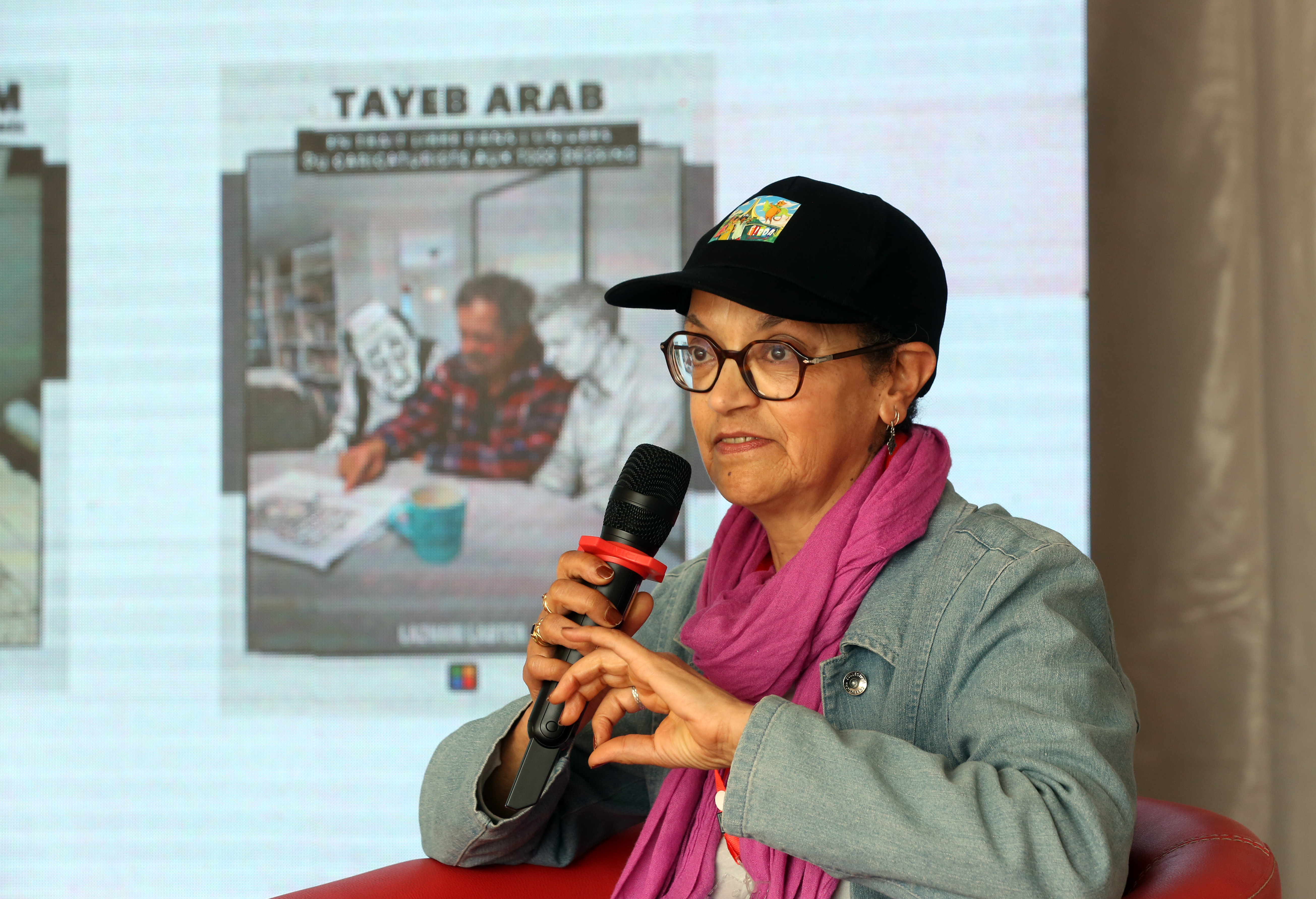
The second day of the Algiers International Comics Festival (FIBDA) was marked on Friday, October 2, by a tribute conference dedicated to Tayeb Arab, who passed away in December 2025 at the age of 78. Hosted by Lazhari Labter, the event retraced the career of a cartoonist, caricaturist and painter who left his mark on the Algerian press, notably through the nearly 7,000 drawings he produced for the daily newspaper La République d'Oran. The tribute was attended by his sister, Fatiha Arab, who came from Paris to represent the family.
At the opening of the event, Lazhari Labter recalled Tayeb Arab's place in the history of drawing in Algeria, while emphasizing the particular emotion of paying tribute to him in the presence of his sister. The speaker also announced the preparation of a book dedicated to the artist, entitled The Cartoonist of 7,000 Drawings.
Born in Oran in April 1947, Tayeb Arab discovered drawing at a very young age. His imagination was shaped in particular by the small-format publications and illustrated magazines that circulated in Algeria during the 1950s and 1960s. Lazhari Labter mentioned such figures as Blek le Roc, Akim, Zembla, The Phantom and Mandrake, publications that were then a source of inspiration for young readers.
"It was in these illustrated publications that Arab drew his inspiration when he was still a child, and later as a teenager," the speaker explained, noting that these publications also served, for an entire generation, as a gateway to drawing and the French language.
Coming from a working-class background, Tayeb Arab had to contribute to his family's needs from an early age. He took on various odd jobs and notably sold illustrated magazines outside cinemas in Oran. At the time, cinema, alongside comics, was one of the main spaces of discovery for young people. Italian films, Westerns, Egyptian productions and, above all, Indian films helped shape the popular imagination.
At the age of 18, Tayeb Arab sent his drawings to the French-language daily La République d'Oran. His talent caught the attention of the editorial staff. He was invited to the newspaper, introduced in a section devoted to young artists, and subsequently hired.
This encounter with La République would transform his career. He worked alongside journalists and artists who helped shape his perspective. Lazhari Labter notably mentioned Bachir Rezzoug, the newspaper's director and editor-in-chief, as well as Kateb Yacine and M'hamed Issiakhem.
"This is where Tayeb Arab's talent would be refined," the speaker explained, emphasizing the importance of this environment in the artist's development.
From 1965 onward, Tayeb Arab gradually established himself as a cartoonist and caricaturist. He also developed his work in comics and created, among others, the character of Kaddour, a deeply Algerian figure published in La République. Between 1965 and 1978, he became the daily newspaper's regular caricaturist.
His work accompanied social and political current affairs. Among the drawings presented during the conference was Qui doit émanciper qui ? (Who Should Emancipate Whom?), which addressed the status of women in Algeria. Another drawing, devoted to the Sabra and Shatila massacre, reflected his perspective on major international events.
The artist was also interested in everyday life and social phenomena. A caricature about the popularity of the American series The Virginian, as well as a panel depicting a viewer's boredom in front of a television that had become almost devoid of content, illustrated the diversity of his work.
From Caricature to Illustration
Tayeb Arab's work was not limited to caricature. He also produced comics and illustrated novels. Lazhari Labter notably presented the panels he created around the Soviet novel How the Steel Was Tempered by Nikolai Ostrovsky, published in the form of panels accompanied by excerpts from the text.
The artist worked across several graphic forms, moving from caricature to press drawing, from comics to illustration, before gradually giving a more prominent place to painting.
In 1978, the Arabization of La République, which became El Djoumhouria, marked a turning point in his career. Tayeb Arab left the newspaper and settled in Bou Ismaïl, near Algiers. He subsequently contributed to Révolution africaine and Algérie Actualité.
His career then took him to France. After settling in Paris in the early 1980s, he notably worked with Afrique-Asie, a magazine headed by Simon Malley. He continued his work as a caricaturist there, turning his attention to African and international current affairs.
Lazhari Labter presented several drawings devoted to African leaders, as well as a two-panel comic strip about Mobutu Sese Seko. Tayeb Arab's line became a means of denouncing abuses of power and offering a satirical view of political regimes.
In 1986, the artist settled in southern France, near Montpellier, and devoted more of his time to painting. This new period was marked by his work on canvas and by the influence of his exchanges with M'hamed Issiakhem and Kateb Yacine.
Among the works discussed during the conference was La Présidente, a painting dedicated to Arlette Casas, his partner and the long-time custodian of his work.
A significant part of the tribute focused on the preservation of his artistic legacy. Arlette Casas, who was absent from the event for health reasons, had sent a message that was broadcast during the tribute held the previous day by the Minister of Culture and Arts.
In it, she called on Algerian institutions to recover Tayeb Arab's works preserved in France and bring them back to Algeria. In particular, she hopes that part of this collection will become part of the Ahmed Zabana Museum in Oran.
This wish is in line with work that has already been undertaken to preserve the thousands of drawings he produced for La République. A preservation initiative made it possible to photograph and digitize drawings published in old issues of the newspaper, following the disappearance of most of the original works.
Tayeb Arab also regained a place in Algeria's cultural memory through several exhibitions held in 2007 and 2008 in Algiers, Oran and Paris. The exhibition Arab, destin d'encre was notably presented at the Moufdi-Zakaria Palace of Culture in Algiers, the Ahmed Zabana Museum in Oran and the Algerian Cultural Center in Paris.
"His Spirit and Soul Will Be Here"
Speaking in turn, Fatiha Arab thanked Lazhari Labter for his work and for the support he had provided to the family in their efforts to preserve and repatriate her brother's work.
She expressed her hope that the initiative would succeed and that the works would eventually join the Zabana Museum in Oran.
"We would really like this to go far, for my brother's works to continue to be repatriated to Algeria and to be donated, well, given as a donation, to the Zabana Museum," she said.
For her, the project goes beyond simply preserving an artistic collection. It also represents a way of bringing Tayeb Arab back to his hometown.
"It will be as if he were buried here, in his country and in his hometown," she said, before adding: "My brother is buried over there, but his spirit and soul will be here as soon as the works are repatriated."